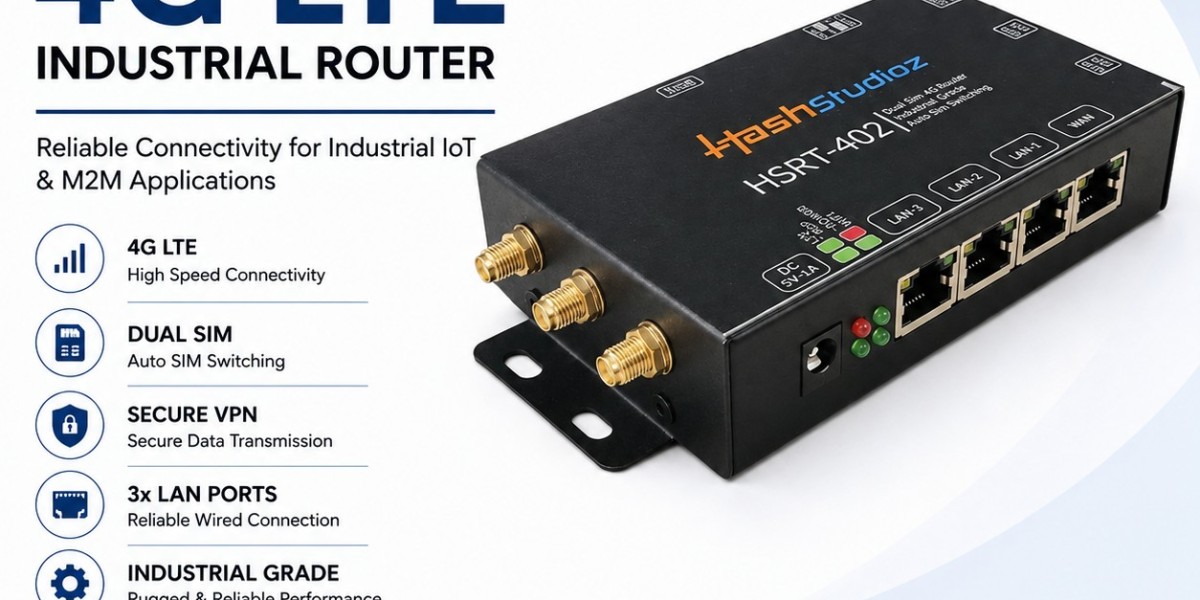


As industries rapidly embrace digital transformation, uninterrupted network connectivity has become a critical requirement for industrial automation, remote monitoring, and Industrial IoT (IIoT) applications. Manufacturing plants, smart cities, oil & gas facilities, transportation systems, renewable energy sites, and utility networks all depend on stable internet connections to ensure continuous data transmission.
Traditional consumer-grade routers often fail in harsh industrial environments due to unstable cellular connections, lack of redundancy, and limited security features. This is where a Dual SIM 4G LTE Industrial Router becomes an ideal solution.
Designed specifically for industrial applications, a Dual SIM Industrial Router provides automatic network failover, secure VPN connectivity, rugged hardware, and continuous communication even in remote or challenging environments.
What is a Dual SIM 4G LTE Industrial Router
A Dual SIM 4G LTE Industrial Router is an industrial networking device that connects machines, sensors, PLCs, RTUs, cameras, and industrial equipment to the internet using two independent SIM cards.
Unlike standard wireless routers, industrial routers offer:
Automatic SIM switching
Industrial-grade durability
Advanced VPN security
Remote device management
High network uptime
Long operating life
Its primary goal is ensuring uninterrupted connectivity for mission-critical industrial operations.
Why Dual SIM Matters
One of the biggest challenges in industrial communication is network downtime.
Cellular providers occasionally experience:
Weak signal
Network congestion
Maintenance outages
Coverage loss
Temporary failures
A Dual SIM Industrial Router eliminates these issues by supporting two cellular operators simultaneously.
If the primary SIM loses connectivity, the router automatically switches to the secondary SIM without manual intervention.
Benefits include:
Maximum uptime
Better network coverage
Business continuity
Reduced maintenance
Improved reliability
Key Features of a Dual SIM 4G LTE Industrial Router
1. Dual SIM Auto Failover
The router constantly monitors network quality.
If the primary SIM fails:
Secondary SIM activates automatically
Existing applications remain connected
Downtime is minimized
No manual reboot required
This feature is essential for remote industrial installations.
2. High-Speed 4G LTE Connectivity
Industrial routers support fast LTE communication suitable for:
Remote monitoring
Industrial automation
CCTV surveillance
Cloud applications
Edge computing
Smart factories
High-speed wireless communication enables real-time data exchange between field devices and cloud platforms.
3. Rugged Industrial Design
Industrial environments expose equipment to:
Dust
Heat
Vibration
Moisture
Electrical noise
Industrial routers are designed with:
Metal enclosure
Wide temperature operation
Industrial-grade components
Long service life
High reliability
Many models include anIndustrial-rated metal case, making them suitable for factory environments.
4. Multiple LAN Ports
Industrial routers often include multiple Ethernet ports that connect:
PLCs
HMIs
Industrial PCs
Cameras
Switches
Industrial gateways
This allows multiple devices to communicate through a single secure internet connection.
5. Advanced VPN Security
Cybersecurity is essential for industrial networks.
Most industrial routers support secure VPN technologies such as:
WireGuard
OpenVPN
IPSec
PPTP
L2TP
GRE
VPN tunnels protect sensitive industrial data during transmission.
Benefits include:
Secure remote access
Encrypted communication
Protection against cyber threats
Safe cloud connectivity
6. Remote Management
Modern industrial routers allow administrators to remotely:
Monitor network status
Update firmware
Configure settings
Diagnose issues
Reboot devices
Track signal strength
Remote management significantly reduces maintenance costs.
7. Wide Power Input
Industrial installations often use different power sources.
Industrial routers generally support wide DC voltage ranges, making them compatible with:
Control panels
Solar systems
Battery-powered installations
Industrial power supplies
Advantages of Using a Dual SIM Industrial Router
Continuous Internet Connectivity
Automatic failover ensures that machines remain online even during carrier outages.
Lower Maintenance Costs
Remote troubleshooting eliminates frequent site visits.
Improved Operational Efficiency
Real-time communication enables faster decision-making and predictive maintenance.
Better Network Security
Industrial VPN technologies safeguard critical business data.
Easy Deployment
Installation is straightforward using standard industrial Ethernet and cellular networks.
Long-Term Reliability
Industrial-grade hardware is built for 24/7 operation under demanding conditions.
Applications Across Industries
Manufacturing
Industrial routers connect:
PLCs
CNC machines
Robotic systems
Production lines
HMIs
They enable centralized monitoring and production analytics.
Smart Cities
Applications include:
Traffic management
Smart lighting
Environmental monitoring
Public Wi-Fi
Parking systems
Oil & Gas
Remote assets such as:
Pump stations
Pipelines
Tank farms
Compressors
can be securely monitored through cellular connectivity.
Renewable Energy
Solar and wind farms use industrial routers for:
Remote diagnostics
Energy monitoring
Performance analysis
Predictive maintenance
Transportation
Industrial routers support:
Fleet management
Railway monitoring
Bus tracking
Vehicle communication
Smart logistics
Water Treatment
Water utilities use industrial routers for:
SCADA communication
Pump monitoring
Reservoir management
Leak detection
Remote maintenance
Retail
Retail businesses benefit from:
Digital signage
POS connectivity
CCTV surveillance
Inventory management
Branch networking










