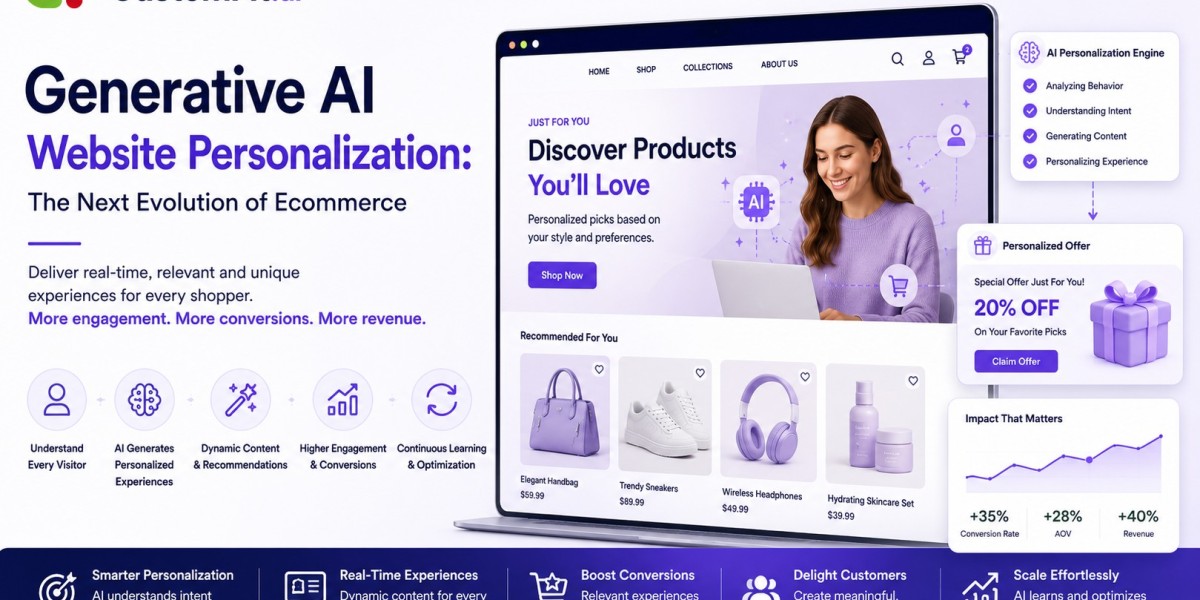


The ecommerce industry has entered a new era in which customers expect highly relevant and personalized digital experiences. Generic product recommendations and static website content are no longer enough to capture customer attention.
Today's shoppers expect brands to understand their preferences, anticipate their needs, and deliver experiences that feel tailored to them.
This shift has accelerated the adoption of Generative AI Website Personalization.
Unlike traditional personalization, which relies on predefined rules and audience segments, generative AI can create dynamic experiences in real time by analyzing customer behavior, preferences, and contextual data.
From personalized product recommendations to AI-generated content and individualized shopping journeys, generative AI is redefining how ecommerce businesses engage with customers.
In this guide, we'll explore how Generative AI Website Personalization works, its benefits, use cases, and why it's becoming the next major advancement in ecommerce optimization.
What Is Generative AI Website Personalization?
Generative AI Website Personalization is the process of using artificial intelligence to automatically create customized website experiences for individual visitors.
Traditional personalization typically follows predefined rules.
For example:
If a visitor views running shoes, recommend more running products.
Generative AI takes personalization a step further.
Instead of relying exclusively on fixed rules, AI analyzes customer behavior and generates unique content, recommendations, messaging, and experiences in real time.
The goal is to create more relevant and engaging customer journeys.
How Does Generative AI Website Personalization Work?
Most AI-powered personalization platforms follow a similar process.
Customer Data Collection
The first step is collecting customer data.
This may include:
- Browsing history
- Products viewed
- Purchase history
- Cart activity
- Device information
- Geographic location
- Referral source
- Previous interactions
- Customer segments
These behavioral signals help AI understand customer intent.
Behavior Analysis
After collecting data, AI analyzes customer behavior to identify patterns.
For example, AI might detect that a visitor consistently interacts with products within a specific category.
This information allows the system to predict customer interests and preferences.
Content Generation
Once customer preferences have been identified, AI can generate personalized website experiences.
This may include:
- Dynamic headlines
- Product recommendations
- Promotional offers
- Personalized CTAs
- Landing pages
- Product descriptions
- Homepage content
Unlike traditional rule-based systems, AI continuously adapts these experiences based on new customer interactions.
Continuous Learning
One of the biggest advantages of generative AI is continuous learning.
Every interaction provides new information.
As customer behavior changes, AI automatically adjusts recommendations and content.
This creates a constantly evolving customer experience.
Generative AI vs Traditional Website Personalization
| Feature | Generative AI | Traditional Personalization |
|---|---|---|
| Real-time adaptation | Yes | Limited |
| AI-generated content | Yes | No |
| Continuous learning | Yes | No |
| Personalization depth | Individual | Segment-based |
| Content creation | Automated | Rule-based |
| Scalability | High | Moderate |
Traditional personalization depends heavily on predefined rules and manual segmentation.
Generative AI Website Personalization creates more flexible and adaptive customer experiences.
Benefits of Generative AI Website Personalization
Better Customer Experiences
Customers are more likely to engage with content that reflects their interests and preferences.
Personalized experiences create more meaningful interactions throughout the customer journey.
Higher Conversion Rates
Relevant recommendations and targeted messaging can reduce friction and encourage customers to complete purchases.
Improved Product Discovery
AI can recommend products that customers may not have discovered through traditional browsing.
This can increase engagement and improve the overall shopping experience.
Increased Average Order Value
Personalized product recommendations can encourage customers to purchase complementary products.
This can positively affect revenue and average order value.
Greater Customer Retention
Relevant experiences often encourage customers to return.
Personalization can strengthen customer relationships and improve long-term engagement.
Use Cases for Generative AI Website Personalization
Personalized Homepages
Generative AI can create different homepage experiences for different visitors.
For example:
- New visitors can see educational content.
- Returning customers can see personalized recommendations.
- High-value customers can receive exclusive promotions.
Dynamic Product Recommendations
Instead of displaying the same products to every customer, AI can generate recommendations based on individual interests.
These recommendations can adapt in real time as customer behavior changes.
AI-Generated Product Descriptions
AI can dynamically adjust product descriptions to emphasize different benefits.
For example, one customer might see messaging focused on affordability, while another might see messaging highlighting premium features.
Personalized Landing Pages
Marketing campaigns often attract visitors with different interests.
AI can create personalized landing pages that align with customer intent and campaign messaging.
Personalized Promotions
Promotional offers can also become more relevant.
Customers interested in a particular product category can receive offers that match their interests.
The Role of AI in Ecommerce CRO
Website personalization is only one part of a broader conversion optimization strategy.
Modern ecommerce businesses increasingly combine personalization with other AI-powered tools.
AI CRO Audits
An AI CRO Page Audit Tool can identify website elements that create friction.
These insights help businesses improve customer experiences before launching personalization campaigns.
AI-Powered Website Editing
An AI Website Visual Editor allows marketers to implement personalization campaigns without extensive coding.
Teams can update headlines, product sections, CTAs, and landing pages through a visual interface.
AI Landing Page Optimization
An AI Landing Page Optimizer can identify opportunities to improve conversion-focused pages.
When combined with personalization, businesses can create landing pages that adapt to individual visitors.
Prompt-Based Website Changes
A Prompt to Website Change Tool allows marketers to describe desired website changes using natural language.
For example:
"Create a personalized homepage for returning customers."
The AI can then generate and implement the experience automatically.
Why Generative AI and A/B Testing Should Work Together
Personalization should always be measured.
Although AI can generate highly relevant experiences, businesses should still validate these changes through experimentation.
A practical workflow might look like this:
Collect Data → Personalize → Test → Analyze → Optimize
A/B testing helps determine whether AI-generated experiences improve:
- Conversion rates
- Engagement
- Revenue
- Product discovery
- Customer retention
This creates a more data-driven personalization strategy.
Best Practices for Generative AI Website Personalization
Start With High-Value Customer Journeys
Focus on pages that directly influence conversions.
Examples include:
- Homepages
- Product pages
- Collection pages
- Landing pages
- Checkout experiences
Use First-Party Data
Reliable customer data improves personalization accuracy.
Prioritize first-party data whenever possible.
Avoid Over-Personalization
Not every website element needs to be personalized.
Focus on experiences that provide meaningful value.
Test AI-Generated Experiences
Never assume that personalization automatically improves performance.
Use experimentation to validate results.
Continuously Monitor Performance
Customer behavior changes over time.
Regular analysis can help businesses identify new opportunities for optimization.
The Future of Ecommerce Personalization
Generative AI is transforming how ecommerce businesses interact with customers.
Future personalization platforms will likely include:
- Predictive product recommendations
- Conversational shopping experiences
- Autonomous experimentation
- AI-generated customer journeys
- Real-time content creation
Instead of creating experiences manually, marketers will increasingly rely on AI to generate, test, and optimize customer interactions automatically.
Conclusion
Generative AI Website Personalization represents the next evolution of ecommerce.
By combining customer data, behavioral analysis, content generation, and real-time optimization, businesses can create experiences that are more relevant, engaging, and conversion-focused.
When integrated with an AI CRO Page Audit Tool, an AI Website Visual Editor, an AI Landing Page Optimizer, and a Prompt to Website Change Tool, generative AI becomes a powerful component of a modern CRO strategy.
As customer expectations continue to evolve, businesses that adopt AI-driven personalization will be better positioned to deliver exceptional digital experiences and achieve sustainable ecommerce growth.









