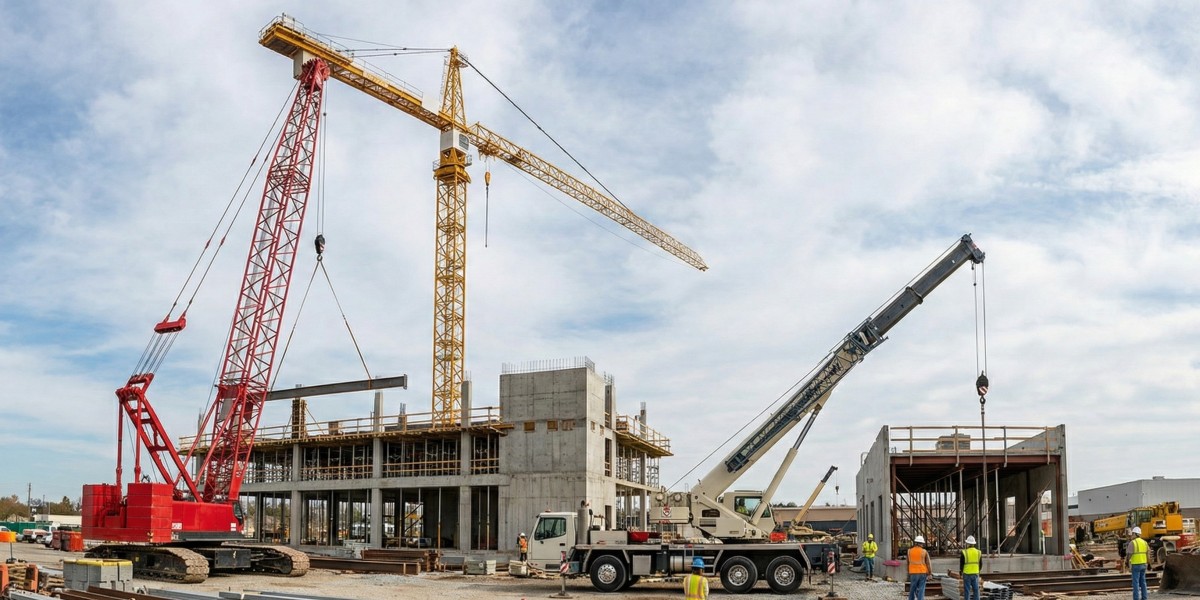


We live in a world of rapid expansion and fast-paced construction of state-of-the-art infrastructure. Therefore, there is no place for old-school or traditional construction equipment anymore in the industry. Among all the equipment, the construction crane is the one that pulls the most weight, especially when it comes to bridges and skyscrapers. In the modern era, where automation is the new gold rush, cranes are no different.
Manual handling of such machines leaves plenty of room for errors. So, now we are seeing the implementation of advanced technologies like real-time telematics and precision engineering. These modern machines are expected to cut down time by as much as 30% to 50%. Yet, you may have the question of how such speed is achieved and whether it comes at the cost of quality.
Well, this article will explore those exact questions in greater detail.
Modern Construction Crane Handles Buildings Like Modular Blocks
The modern sector of construction has pretty much done away with constructing large-scale infrastructure from bottom to top. Many of the critical components are constructed somewhere in a factory and then delivered to the site. Construction cranes simply lift such preconstructed blocks and place them appropriately to where they should be placed. This type of construction has expanded to hotel rooms with plumbing pre-installed to bridge spans, and many more.
As mentioned before, this style of construction technique is only possible due to the presence of the construction crane. They are capable of grabbing these modular blocks and placing them at the desired position.
They allow for the rapid "plug-and-play" assembly of heavy modules in the first place. By replacing onsite construction from scratch with the assembly of premade parts, the project timing can be cut in half easily. For example, previously, a 10-story building used to take a year, but with this method, it is now topped out in months.
Construction Crane Provides Precise and Errorless Work
Back in the day, construction crane operators had to rely entirely on radio signals. They used to receive these signals from what is known as "banksman," or simply a rigger on the ground. This created a lot of room for error as the varying perspectives of the rigger and the operator created what's known as "blind lifting." This not only slowed the process of construction down, but also led to risky errors.
Therefore, to combat this issue, a modern construction crane comes with hook-mounted cameras and IoT sensors. For example, hook-mounted cameras provide high-definition visuals to the operator.
They can precisely see the load from the cab, even when working behind the obstacles. Furthermore, these cranes are equipped with Anti-Collision Systems software that automatically slows or stops them when there is a potential for collision. The sensors on these cranes also calculate in real-time the load patterns and wind speeds instantly for added safety.
Rapid Evolution of Modern Cranes in Cramped Urban Settings
As urban cities become more and more cramped with the rapid construction of skyscrapers, it is necessary for modern cranes to adapt quickly. Usage of long, fixed horizontal jibs in cranes is no longer an option due to their limitation to rotate freely without hanging over neighboring buildings or other cranes. To solve this problem, construction crane manufacturers are bringing new types of models.
You will encounter fast adaptation of luffing jib cranes, where they can raise and lower their working arm or jib like an upraised finger. This specialised movement allows the multiple cranes to work simultaneously in the same vicinity without interfering with one another. This leads to faster and efficient workflow without having to wait for one crane to finish their job, so another one can start. The implementation of such cranes is one of the reasons why modern construction time has been reduced by almost half.
A Construction Crane Can be Maintained Remotely
We all know the sheer horror of a construction crane breaking down in the middle of a job. To prevent such issues from occurring, fleet managers can observe the data on engine hours, fuel consumption, and structural stress from afar through telematics technology. They can also equip each crane with a special suite of software to predict when a wire rope or hydraulic seal is likely to fail before it actually does.
Such cutting-edge tech enables managers to predict the structural integrity of the cranes and schedule maintenance for them during off-hours. They can avoid any unwanted breakdown or other catastrophic failures that will increase the cost of the project immensely. Many projects in the past had to delay deadlines due to sudden breakdowns, but now, a new gen construction crane is equipped with necessary failsafes to prevent that from happening.
Small Improvements Make Modern Cranes Better
Traditional tower cranes were notorious for setting up, as it would take almost two days for continuous labour and assistance from multiple mobile cranes. However, in this era, for low-to-medium-rise projects, self-ejecting cranes are making the job faster. They do this by using their own hydraulics to unfold and stand up in a matter of hours. Thus, this rapid process of setting up enables the beginning of the project from day one.
On the other hand, deployment of modern luffing jib cranes helps the project to be divided into sections where each crane looks after different sites while working simultaneously. For example, one crane might pour concrete, while another installs glass panels at the same time.
Today, the best construction cranes have digital twin integration that allows them to move in a predesigned, simulated movement. Ensuring that the heavy load will fit through tight spaces or land exactly on its bolts without trial and error.
Conclusion
Now you know how a modern and advanced construction crane is capable of completing the same amount of work in a fraction of the time it used to take for older models. Technological development is not limited to flashier equipment. We are seeing more sophisticated tech coming into the construction industry and speeding projects up while maintaining a great deal of safety.










