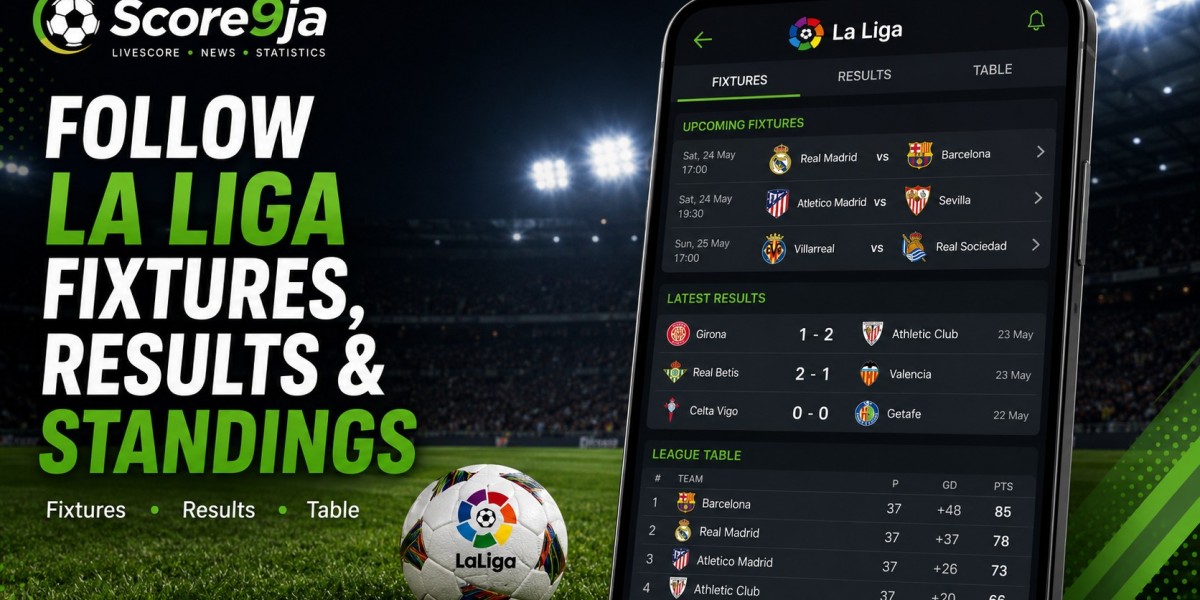


Following La Liga across an entire season involves more than checking the score when Real Madrid, Barcelona or another major Spanish club plays.
Every matchday contributes to a wider league story. Upcoming fixtures show which teams meet next, completed results reveal where points were won or dropped, and the league table shows how those outcomes affect each club's position.
For fans who want to follow Spanish football consistently, the easiest approach is to connect these three pieces of information:
Fixtures → Results → Standings
Here is how to use them together to keep track of La Liga throughout the season.
Start With the La Liga Fixture Schedule
Fixtures tell you what is coming next.
Rather than searching separately for every club, use a dedicated La Liga fixtures and match schedule page to view upcoming league games together.
A fixture list can help you check:
home and away teams;
match dates;
scheduled kick-off times;
upcoming rounds;
postponed or rescheduled matches;
available match-centre links.
This is particularly useful before a weekend matchday.
Instead of only knowing when your favourite team plays, you can see the entire round and identify other matches that could influence the league table.
Look at the Full Matchday
La Liga rounds are often spread across several days.
You may have matches on Friday, Saturday, Sunday and Monday rather than every club playing at the same time.
That makes it useful to review the full matchday before games begin.
Suppose several clubs near the top of the standings are playing during the same round. Their fixtures may not overlap, but every result could affect the same title race.
Likewise, several teams near the bottom may be fighting for important points.
Looking at the complete round gives you more context than concentrating on one match.
Check Kick-Off Times Carefully
Once you find the fixtures you want to follow, note their kick-off times.
This is especially important for Nigerian fans following Spanish football, as match times may be spread across the afternoon and evening.
A simple matchday plan might look like:
Early fixture → Afternoon match → Evening game → Late fixture
Knowing the schedule helps you decide which matches you can watch and which ones you may need to follow through live scores.
Fixtures can also be moved, so checking the current schedule close to matchday is more reliable than depending on an old screenshot or calendar.
Follow Individual La Liga Teams
Not every supporter wants to monitor all 20 clubs equally.
You may primarily follow:
Real Madrid;
Barcelona;
Atletico Madrid;
Sevilla;
Villarreal;
Athletic Club;
Real Sociedad;
Valencia;
Real Betis.
If that is the case, team pages can help you concentrate on one club's schedule and recent matches.
The league fixture page remains useful, however, because it shows how your team's games fit into the wider competition.
This becomes increasingly important when clubs begin competing directly for similar positions.
Move From Fixtures to Live Matches
Before kick-off, you are following a fixture.
After the referee starts the game, that fixture becomes a live match.
The information you need also changes.
Before the match:
Who plays and when?
During the match:
What is the score now?
Afterward:
What was the final result?
This simple progression makes football platforms easier to use.
If several La Liga games are taking place during the same period, live scores can help you monitor them without needing to watch every match simultaneously.
Confirm the Final Result
Never assume a live score is the result.
For example:
Barcelona 2-1 Valencia — 73'
is only the current score.
If Valencia equalise later and the game finishes 2-2, then the confirmed result is different.
Once a game reaches full-time, supporters can use the latest La Liga results to review completed matches and final scores.
Results pages are especially useful after a busy weekend when you want to catch up on several games at once.
Review the Whole Round of Results
Checking only your club's final score gives you part of the story.
Suppose Real Madrid win.
Whether that victory creates a major advantage depends partly on what Barcelona, Atletico Madrid and other nearby teams do.
The same applies throughout the standings.
A team fighting near the bottom may win an important match, but if every nearby club also collects points, its league position may remain almost unchanged.
For that reason, after checking your team's result, scan the rest of the round.
Use Results to Understand Recent Form
A team's latest result matters, but several completed matches usually provide a more useful picture.
For example:
W – W – D – L – W
tells a more complete story than simply saying the club won its latest game.
When reviewing La Liga form, look for patterns such as:
consecutive victories;
repeated draws;
difficulty away from home;
improved defensive results;
recovery after a losing run.
Recent results can help explain why a team is rising or falling in the standings.
Check the La Liga Table After Matchday
The table is where individual results become part of the season.
After games have finished, check the La Liga table and standings to see how positions have changed.
The table typically helps you compare:
matches played;
wins;
draws;
defeats;
goals;
goal difference;
points;
league position.
A final score tells you what happened in one game.
The standings tell you what that result means.
Understand the Title Race
At the top of La Liga, small point gaps can make individual fixtures especially important.
Suppose the leading two clubs are separated by only two points.
If the leader draws and the second-placed club wins, the order could change immediately.
The fixture list helps you see which opponents are coming next.
The results show what happened.
The table confirms the new situation.
That is why following all three together provides a much better understanding of a title race.
Follow European Qualification Positions
La Liga is not only about finishing first.
Positions further down the table can also matter for qualification to European competitions.
Several clubs may remain separated by only a few points for much of the season.
A single matchday can therefore change several positions.
Checking the standings regularly helps you see which teams are moving upward and which are losing ground.
Watch the Relegation Battle
The bottom of the table can change just as quickly as the top.
When several teams are separated by one or two points, one victory can potentially move a club above multiple rivals.
This is where checking other teams' results becomes especially important.
A club's own performance is only one part of the calculation.
If teams around it also win, the gap may remain almost unchanged.
Pay Attention to Matches Played
Do not compare teams using points alone.
Occasionally, clubs have played different numbers of fixtures because of postponements or rescheduled matches.
For example:
Club A — 35 points from 20 matches
Club B — 33 points from 18 matches
Club A currently has more points, but Club B still has two games to play.
This is why the matches played column is important when reading the standings.
Games in hand provide opportunities, but they do not guarantee additional points.
Connect One Matchday to the Next
Following La Liga becomes much easier when you stop treating each weekend as an isolated event.
After a round finishes:
Review the results.
Check the updated table.
Identify which positions changed.
Look at the next fixtures.
Note any important direct meetings.
Then repeat the process after the following round.
This creates a continuous view of the season.
Use One Simple La Liga Routine
You do not need to check dozens of pages every day.
A useful routine is:
Before matchday: Check the La Liga fixtures.
During matches: Follow important live scores.
After full-time: Confirm the La Liga results.
After the round: Review the standings.
Then: Look ahead to the next fixtures.
That cycle covers most of what a supporter needs to understand how the league is developing.
Final Thoughts
The best way to follow La Liga fixtures, results and standings is to use them as connected parts of the same competition.
Fixtures tell you what is coming.
Live scores show what is happening.
Results confirm what happened.
The table explains what those results changed.
Score9ja separates La Liga into dedicated fixture, result and standings sections, making it easier to move from the upcoming match schedule to completed scores and then to the latest league positions.
Whether you follow Real Madrid, Barcelona, Atletico Madrid or the league as a whole, using that simple fixtures → results → standings routine provides a clearer picture of La Liga throughout the season.






