

Apostille vs Attestation: Key Differences You Should Know
If you are planning to use your Indian documents abroad for education, employment, immigration, marriage, business, or residency, understanding the difference between apostille and attestation is extremely important. Secure Apostille Services Bangalore helps individuals and businesses understand the correct legalization process based on the destination country and document type. You can also explore our Secure Apostille Services Hyderabad for professional document legalization assistance in Hyderabad.
Choosing the wrong process can result in unnecessary expenses, delays, or rejection by the receiving authority. Although apostille and attestation both authenticate documents for international use, they are used under different international legalization systems.
What Is Apostille?
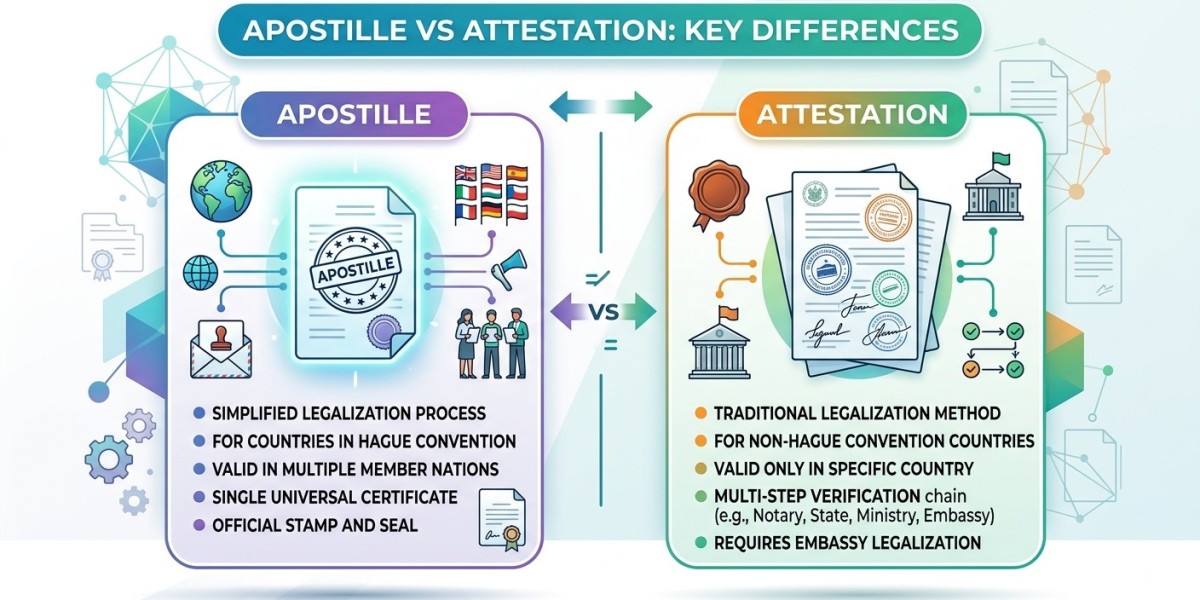
An apostille is a certificate attached to or placed on a public document to authenticate it for use in another country that is a member of the Hague Apostille Convention. In India, apostilles are issued by the Ministry of External Affairs (MEA).
The purpose of an apostille is to confirm the authenticity of the signature, seal, or stamp appearing on the document. It does not certify the actual contents of the document.
Common documents that may require apostille include:
- Birth certificates
- Marriage certificates
- Degree certificates
- Diploma certificates
- Police Clearance Certificates
- Single Status Certificates
- Affidavits
- Power of Attorney
- Commercial documents
- Certificates of incorporation
The exact verification required before MEA apostille can depend on the type of document and the issuing authority.
What Is Attestation?
Document attestation is a legalization process generally used when the destination country does not follow the Hague Apostille Convention for the particular document or purpose.
Unlike apostille, attestation may involve several levels of authentication. Depending on the document and destination country, the process can include notarization, state-level authentication, MEA authentication, and verification by the embassy or consulate of the destination country.
Countries commonly associated with embassy legalization procedures include the UAE, Qatar, Kuwait, Saudi Arabia, and several other destinations.
Because requirements can vary by country, document type, and purpose, applicants should confirm the exact procedure before submitting their documents.
Apostille vs Attestation: Main Difference
The simplest way to understand the distinction is to consider the destination country.
If the destination country accepts the Hague Apostille Convention, an apostille may generally be the appropriate legalization method. If the destination country requires embassy or consular legalization, attestation may be necessary.
Apostille is generally a streamlined form of international document authentication because the Hague Convention removes the need for legalization by the embassy of another member country.
Attestation can involve more stages because the document may need authentication from multiple authorities before it is accepted abroad.
Which Countries Require Apostille?
Many countries recognize apostilled documents under the Hague Apostille Convention. Examples include the United States, United Kingdom, Germany, France, Italy, Spain, the Netherlands, Australia, and several other countries.
However, applicants should not assume that every document automatically qualifies for the same procedure. The document category, issuing authority, destination country's requirements, and intended use can affect the process.
For example, educational documents may require additional verification before MEA processing, while certain personal documents may follow a different authentication route.
Which Countries Require Attestation?
Countries that are not parties to the Hague Apostille Convention may require a different legalization procedure. The UAE is a common example for Indian applicants.
For UAE document use, applicants may need to complete several stages before the document is accepted by the relevant authority. Depending on the document, this can involve notarization, state authentication, MEA processing, and UAE Embassy or consular legalization.
Similar requirements may apply to documents intended for countries such as Qatar, Kuwait, or Saudi Arabia, although the exact procedure should always be confirmed before processing.
Does Apostille Mean Embassy Attestation Is Not Required?
For documents intended for a Hague Convention country where apostille is accepted for the intended use, embassy legalization is generally not required after apostille.
This is one of the major advantages of the Hague system. Instead of completing separate legalization at the destination country's embassy, the apostille provides the standardized authentication required under the convention.
However, the receiving institution can still have additional requirements. A university, employer, immigration department, court, or government authority may request a particular document format, translation, validity period, or supporting certificate.
Therefore, obtaining an apostille does not automatically guarantee acceptance for every purpose.
Which Documents Can Be Apostilled?
A wide range of personal, educational, and commercial documents can potentially be apostilled.
Personal documents may include birth certificates, marriage certificates, death certificates, PCCs, affidavits, and single-status documents.
Educational documents can include degree certificates, diplomas, transcripts, and other academic records. These documents may require verification by the appropriate state or educational authority before MEA processing.
Commercial documents can include powers of attorney, certificates of incorporation, agreements, invoices, board resolutions, and other business-related paperwork.
The required procedure should be checked before submission because different document categories may follow different authentication routes.
Why Choosing the Correct Process Matters
One of the most common mistakes applicants make is assuming that all international documents require the same type of legalization.
For example, someone moving to Germany may need an apostille, while someone relocating to the UAE may need embassy attestation. Using an apostille when embassy legalization is required can result in the document being rejected.
Similarly, completing unnecessary attestation for a destination that accepts apostille may increase processing time and cost.
Professional guidance can help applicants identify the appropriate route before handing over their original documents.
Apostille and Attestation for Educational Documents
Students and professionals frequently require legalization of degree certificates, diplomas, transcripts, and other educational records.
Educational documents can involve additional verification because authorities need to establish the authenticity of the qualification before final legalization.
The exact procedure can depend on the state where the educational institution is located, the type of certificate, and the country where the document will be submitted.
Applicants should therefore avoid relying on a general procedure for every educational certificate.
Apostille and Attestation for Personal Documents
Personal documents are commonly required for immigration, family reunification, marriage registration, employment, and residency applications.
Birth certificates may be needed to establish identity or family relationships. Marriage certificates may be required for spouse or dependent applications. Police Clearance Certificates can be requested for immigration or employment purposes.
Before beginning the process, applicants should verify that names, dates of birth, certificate numbers, and other important details are accurate. Errors or discrepancies can create problems during authentication.
How Secure Apostille Services Can Help
Secure Apostille Services assists applicants with the documentation and legalization process based on their destination country and document requirements.
The service can include document review, guidance on the appropriate authentication route, verification support, processing, tracking, and document delivery.
For applicants in Bangalore, professional assistance can be particularly useful when dealing with educational documents, older certificates, personal documents, or urgent international applications.
Applicants in Hyderabad can also use our Hyderabad apostille service for assistance with document authentication and legalization.
Conclusion
Apostille and attestation are not interchangeable terms. The correct process depends primarily on the destination country, the type of document, and the purpose for which it will be used.
Apostille is generally used for documents intended for countries covered by the Hague Apostille Convention, while attestation and embassy legalization may be required for destinations outside that system.
Before submitting your original documents, verify the requirements of the receiving authority and destination country. Understanding the difference in advance can help prevent unnecessary costs, delays, and rejected applications.
If you are unsure whether your document requires apostille or attestation, Secure Apostille Services can help you understand the appropriate process and guide you through the required documentation.






