

The National Institute of Standards and Technology recently updated its guidelines with the release of NIST SP 800-63-4. While the core goals of Identity Assurance Level 3 (IAL3) remain the same—to provide the highest degree of certainty in a user's identity—the methods have modernized. The latest revision formally recognizes that high-assurance IAL3 identity proofing can be achieved remotely, provided it is "supervised" and utilizes a "trusted path."
This shift is critical for the 2026 workforce. Organizations no longer have to choose between the extreme friction of in-person visits and the security risks of unsupervised remote verification. By leveraging a combination of trained human representatives and hardware-anchored security, IAL3 now supports a seamless, global onboarding experience.
The Pillars of IAL3 Identity Proofing
To achieve NIST 800-63A IAL3, the verification process must go beyond simple document scans. It requires three specific technical and procedural pillars:
1. Superior Evidence: Applicants must provide "superior" strength evidence—typically a cryptographic e-Passport or a combination of multiple "strong" documents (like a REAL ID) that are verified against authoritative government databases.
2. Mandatory Biometrics: Unlike IAL2, where biometrics may be optional, IAL3 requires a mandatory biometric match (usually facial) with liveness detection to ensure the applicant is a real person and the rightful owner of the evidence.
3. Supervised Interaction: Every session must be overseen by a trained representative. This "human-in-the-loop" requirement prevents advanced injection attacks, where hackers attempt to feed synthetic video or deepfakes directly into the verification stream.
Solving the Logistics of an IAL3 Compliant Solution
The biggest hurdle for enterprise adoption has always been the logistics of the "Trusted Path." Standard consumer smartphones, while powerful, lack the tamper-evident hardware required for IAL3. Trust Swiftly solves this by providing a turnkey infrastructure that includes shippable Remote Kits and On-Premise Kiosks.
Our Remote Kits are secured, dedicated devices shipped directly to the user. These devices provide an isolated environment, preventing malware or virtual camera software from interfering with the identity capture. This ensures that the data reaching the verifier is "pure" and satisfies the most stringent 3PAO (Third-Party Assessment Organization) audits.
Cryptographic Certainty via NFC Technology
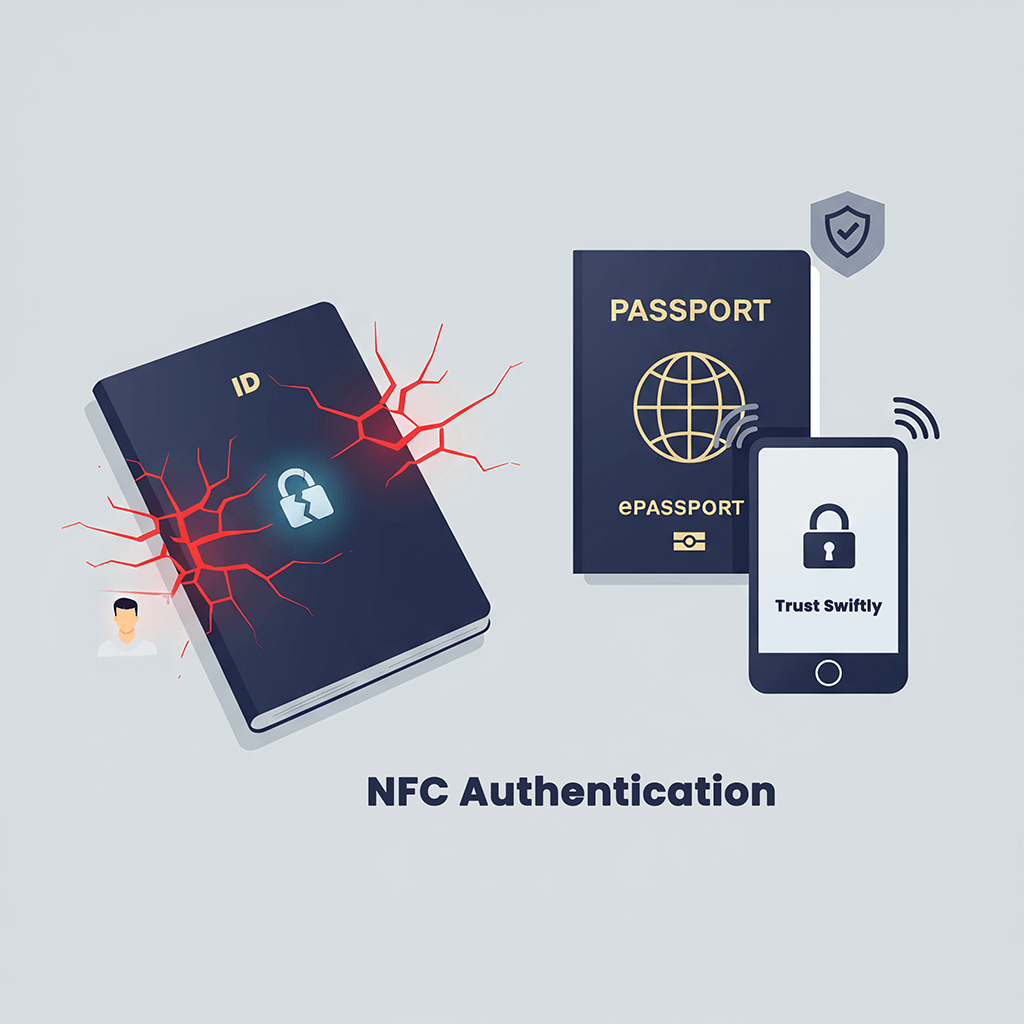
A cornerstone of modern NIST IAL3 verification is the move away from visual OCR (Optical Character Recognition) toward cryptographic validation. Trust Swiftly utilizes NFC (Near Field Communication) to read the encrypted chip inside modern passports and ID cards.
Because this data is digitally signed by the issuing government, it provides absolute certainty that the document is genuine. In an era where AI can generate perfect visual forgeries of physical cards, the digital signature on the NFC chip remains an unhackable source of truth.
Why IAL3 is Essential for Zero Trust in 2026
In 2026, identity is the new perimeter. Statistics show that nearly 90% of modern breaches are due to identity vulnerabilities, with average losses exceeding $2.5 million per incident. Relying on IAL1 or IAL2 for privileged access is like locking your front door but leaving the windows wide open.
By implementing an IAL3 standards for remote workers compliant solution, you are moving to a "Continuous Assurance" model. You aren't just checking an ID once; you are establishing a cryptographically bound identity that can be used for phishing-resistant MFA (AAL3) throughout the user's lifecycle. This holistic approach ensures that from the moment of hire to the most sensitive server access, the person behind the keyboard is exactly who they claim to be.
The Future of High-Assurance Onboarding
The traditional model of legacy in-person proofing—sending employees to a DMV or a retail storefront—is being replaced by decentralized, hardware-anchored models. Trust Swiftly allows you to scale high-assurance verification across 195+ countries without the overhead of physical offices.
This decentralized approach doesn't just improve security; it improves the user experience. High-value employees and contractors can complete their verification from their home or a satellite office in minutes, rather than days. The result is a faster time-to-productivity and a security posture that is ready for the threats of tomorrow.










