

Every proposal for healthcare app development eventually hits the same line item: "EHR integration." Few clients get a real number attached to it before the contract is signed, which is how budgets blow up in month four. In 2026, the honest range runs from roughly $15,000 for a single read-only FHIR connection up to $150,000+ for bidirectional sync across multiple platforms — and where a project lands in that range depends less on how sophisticated the app is than on which EHR it connects to and whether it writes data back or only reads it.
Why Epic, Cerner, and Athenahealth Price So Differently
All three vendors now support FHIR R4, so the underlying data standard is shared. What isn't shared is how each vendor treats outside developers, and that's what actually drives cost in custom healthcare app development projects.
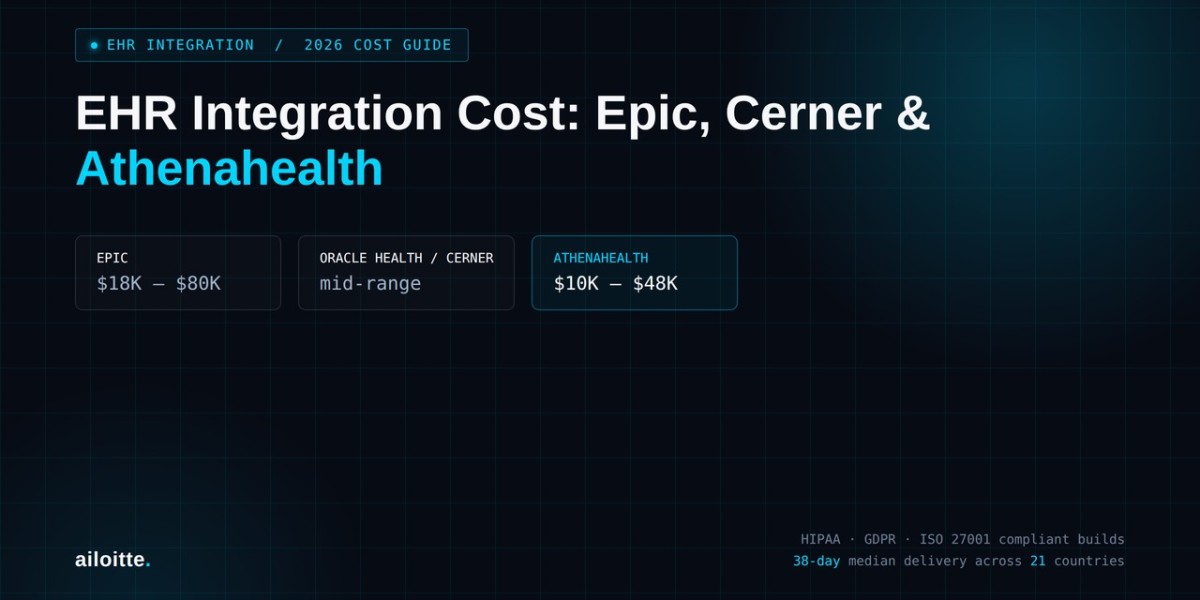
Epic is the most expensive to integrate with, typically $18,000 to $80,000, mostly because of its certification process — app review, security assessment, and per-health-system approval that can take four to six weeks at every individual site. That premium buys reach: Epic runs the largest share of US acute-care hospitals, so for many products it's the integration that matters most.
Athenahealth is generally the cheapest of the major platforms, around $10,000 to $48,000. Its developer program was built API-first for third parties from the start, with a large marketplace of pre-built endpoints, so less engineering time goes into fighting the certification process itself.
Oracle Health (formerly Cerner) usually lands between the two, with published developer program fees layered on top of engineering costs — membership and platform access fees separate from the integration build itself.
What Actually Sets the Final Number
1. Read-only vs. bidirectional access. Pulling data — labs, demographics, appointments — into your app is the cheaper path. Writing data back into the EHR (scheduling, clinical notes) triggers extra validation, error handling, and certification review that pushes costs toward the top of each vendor's range.
2. Number of interfaces stacked. Each additional data feed — labs, meds, scheduling — adds its own integration and certification overhead, even within the same EHR vendor.
3. The maintenance line most quotes leave out. EHR APIs version, hospitals upgrade on their own schedules, and certifications need renewal. Budgeting $3,000 to $15,000 per interface, per year for maintenance is what separates a realistic proposal from one that fails in year two.
Why This Belongs in the Proposal, Not the Invoice
A healthcare app development company that quotes EHR integration as a flat line item, without specifying vendor, access direction, and interface count, is giving you a placeholder, not a budget. Ailoitte's healthcare app development services scope EHR integration by vendor and access type before a statement of work is signed, so the number in the proposal is the number that holds — part of how our healthcare mobile app development projects stay on budget through a 38-day median delivery.
FAQ
Q: Which EHR is cheapest to integrate with in 2026? A: Athenahealth is generally the least expensive of the major platforms, since its developer program was built API-first for outside developers from the start.
Q: Why does Epic integration cost more than Cerner or Athenahealth? A: Mostly due to its certification process — per-health-system app review and security assessment — rather than the underlying engineering work, which is similar across vendors.